"What Is Nvidia Actually Buying With Hugging Face?"
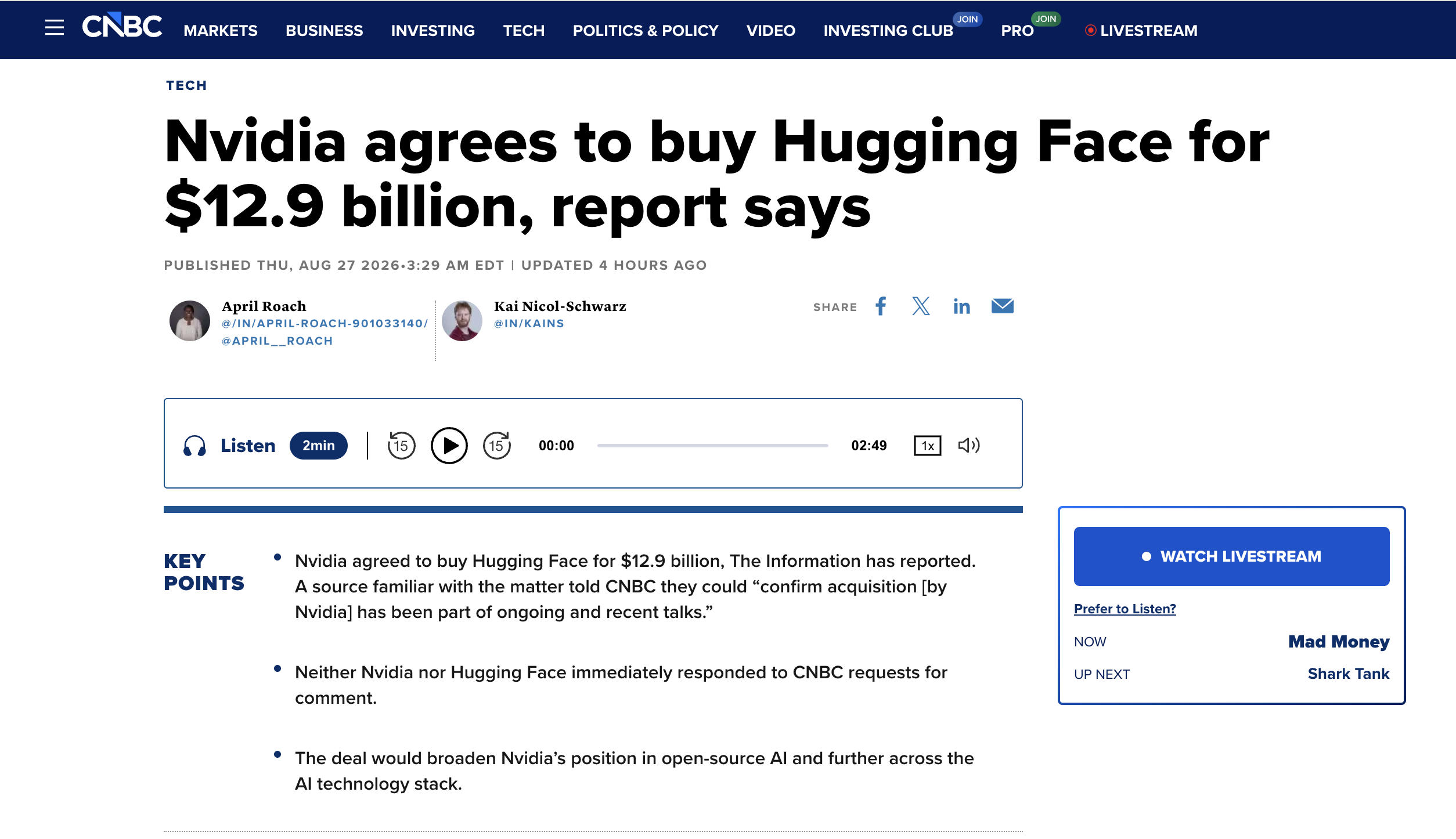
In late 2025, Nvidia offered Hugging Face a $500M minority stake at a $7B valuation. Hugging Face declined, citing platform neutrality — they didn’t want a single chip giant to have outsized influence.
Nine months later, Nvidia agreed to buy the entire company for $12.9B.
The Information broke the story. CNBC independently confirmed the acquisition “has been part of ongoing and recent talks.” Negotiations began after Hugging Face received an acquisition bid from another company — Business Insider reported that Hugging Face had hired investment banks to evaluate competing offers.
Neutrality wasn’t the sticking point. Price was.
The Numbers
| Item | Figure |
|---|---|
| Acquisition price | $12.9B |
| 2023 Series D valuation | $4.5B (led by Salesforce; Google, Amazon, Nvidia, AMD, Intel participated) |
| Late 2025 rejected investment valuation | $7B |
| Acquisition vs 2023 valuation | ~3x |
| Annual revenue | ~$150M |
| Price-to-revenue | ~86x |
| Nvidia Q2 FY2027 revenue | $96.2B (+106% YoY) |
| Nvidia order backlog | > $2 trillion |
$12.9B divided by $150M is about 86x price-to-revenue. That’s a lunatic multiple for a SaaS company. But Nvidia isn’t buying a SaaS company.
Put it differently: Nvidia’s quarterly revenue is $96.2B. This acquisition is roughly two weeks of income. If owning Hugging Face increases GPU demand by even 10%, the additional annual revenue pays for the acquisition several times over. For a company with an order backlog exceeding $2 trillion, $12.9B isn’t an investment — it’s a rounding error.
Why Nvidia Needs Open Source to Win — The Structural Motivation
To understand this deal, you need to understand the symbiotic relationship between Nvidia’s revenue and open-source models.
First, a clarification: closed models run on Nvidia GPUs too. OpenAI’s data centers are packed with H100s. So are Anthropic’s. Training and inference both require GPUs regardless of whether models are open or closed. Nvidia profits from both sides.
But the customer structures are completely different.
Closed-model GPU buyers are a handful of hyperscalers — OpenAI, Google, Amazon, Microsoft. These companies share three traits: enormous bargaining power, high order concentration, and active efforts to develop their own chips. Google has TPU, Amazon has Trainium, Microsoft is building Maia, and Anthropic just confirmed an in-house chip team in August 2026 targeting 50% inference cost reduction. The more closed models concentrate in these few hands, the more Nvidia’s revenue depends on a small group of customers actively trying to leave.
Open-model GPU buyers are thousands of enterprises and developers. Every company that chooses to run its own inference needs GPUs — and none has the scale to design custom silicon. Customers are dispersed, bargaining power is low, and alternatives are few.
In a closed-model world, Nvidia’s customers are a few giants building their own chips. In an open-model world, Nvidia’s customers are the entire market.
That’s the structural reason Nvidia is betting on open source. Not that it doesn’t profit from closed models — those orders keep coming. But open models expand the population of GPU buyers, reduce customer concentration risk, and these customers depend on Nvidia far more deeply than hyperscalers do.
And Hugging Face is the funnel mouth for this entire ecosystem.
How Wide Is the Funnel: Open Models Exploding Across Four Tiers
This funnel isn’t growing steadily — it’s surging. In the past six months, open-source models have exploded simultaneously across every size tier:
- Edge / small models (< 15B): Proliferating from every major lab — laptops, phones
- Consumer-grade (27B–35B): Qwen-dominated 27B / 35B battlefield — single RTX 5090
- Mid-size MoE (125B–284B): DeepSeek V4 Flash (284B), Qwen3.8-Flash-Next (125B), GLM 5.3 Flash — dual DGX Spark or RTX 5090 + 256GB RAM
- SOTA flagships (> 800B): Kimi K3, GLM 5.3, DeepSeek V4 Pro (1.6T) — multi-GPU rigs
Two years ago, open models occupied one tier: “usable but significantly worse than closed.” Now, from phones to multi-GPU rigs, every tier has deployable open options — and performance is rapidly closing in on closed flagships. Kimi K3 and GLM 5.3 score 60 on the Artificial Analysis Intelligence Index; closed flagship Fable 5 scores 62. The gap is down to 2 points.
Qwen3.8-Flash-Next was released the day before the acquisition news (August 26) — weights went straight to Hugging Face.
This is the landscape Nvidia sees: open models aren’t just chasing closed models, they’re expanding across every compute tier simultaneously. Each new tier creates a new batch of GPU customers, a new batch of developers downloading models from Hugging Face. The funnel is widening, and Nvidia just bought the funnel mouth.
86x Is Not Buying Revenue — It’s Buying the Funnel
Hugging Face, founded in 2016, is the distribution hub for open-source AI models. Developers publish, download, test, and deploy models on it. Meta’s Llama, Mistral, DeepSeek, Qwen — all major open-source model weights flow through Hugging Face.
“The GitHub of open-source AI” isn’t a metaphor. It’s a functional description.
A developer discovers a model on Hugging Face, downloads it, and the next question is: what hardware do I run it on? If the platform defaults to CUDA-optimized versions, TensorRT-LLM deployment guides, and Nvidia GPU benchmarks, the developer’s choice is already being steered. Hugging Face is the top-of-funnel for GPU sales. Whoever owns the funnel mouth doesn’t need to compete at the bottom.
86x revenue isn’t buying a company’s earnings — it’s buying a chokepoint’s position. When Microsoft acquired GitHub for $7.5B in 2018, GitHub’s revenue couldn’t justify that price either. Microsoft was buying the distribution node for global code collaboration. Nvidia’s logic is the same: everyone running open models has to come through here.
In February, Hugging Face acquired GGML.ai, bringing quantized inference technology into its portfolio. This isn’t just a model repository — it’s extending into the inference layer. Under Nvidia’s ownership, that extension will accelerate — in Nvidia’s direction.
There’s another layer: Hugging Face isn’t just models. It’s datasets, Spaces (demo apps), and evaluation tools. It’s a full-lifecycle platform for models. Owning this platform gives Nvidia visibility into the entire market’s demand trajectory — which models are downloaded most, which tasks are hottest, where compute demand is moving. That’s product-roadmap-level strategic intelligence.
GPU Commoditization Defense
Nvidia isn’t just expanding. It’s defending.
In data centers, AMD MI300X, Intel Gaudi, Google TPU, and Amazon Trainium are all attacking GPU territory. But the most notable threat isn’t in the data center — it’s on the desktop.
Apple announced the M5 Ultra Mac Studio three days ago (August 25): up to 512GB unified memory, 1.2TB/s bandwidth, starting at $5,499. Hundred-billion-parameter open models fit entirely in memory. Four Mac Studios can be linked via Thunderbolt 5 into a shared memory pool, tripling AI inference speed. The simultaneously announced M6 Mac mini is Apple’s first 2nm chip, starting at $899.
This means individual developers don’t necessarily need Nvidia GPUs to run open models anymore. A single Mac Studio can run Llama, DeepSeek, Qwen — no CUDA, no discrete GPU. Apple is turning “running AI at home” from a hobbyist activity into a consumer electronics feature.
The more hardware alternatives exist, the shallower Nvidia’s hardware moat becomes. The moat has to move up — to the ecosystem layer.
But regardless of whether you run models on Nvidia GPUs or Apple Silicon, you download them from Hugging Face.
Controlling Hugging Face means building a hardware-agnostic barrier at the model distribution layer. No need to block other hardware — just make Nvidia’s path smoother: more complete CUDA-optimized versions, deeper TensorRT-LLM deployment guides, more prominent Nvidia GPU benchmarks. Before developers choose hardware, they’ve already chosen models on Nvidia’s platform. The order of choice determines the outcome’s bias.
The more intense hardware competition gets, the more valuable distribution platform control becomes. Apple Silicon’s rise doesn’t make Hugging Face less important — it makes it more important, because it’s the only cross-hardware common entry point.
This parallels Google’s acquisition of Android. When Google bought Android in 2005, Android had virtually no revenue. Google was buying the mobile ecosystem’s distribution channel — ensuring its search engine was the default on every phone. Nvidia buying Hugging Face ensures that every open-source model’s deployment path defaults toward Nvidia’s hardware — even as hardware competitors multiply.
Nvidia’s Full-Stack Chess Game
Place this deal in the context of Nvidia’s moves over the past year:
- 2025-12: $20B Groq licensing deal (licensing-and-acquihire) → low-latency inference chip technology (LPU)
- Late 2025: $500M minority stake offer to HF, rejected
- 2026-08-26: Q2 earnings: $96.2B revenue, stock up ~5% after hours
- 2026-08-27: Agrees to $12.9B HF acquisition → model distribution platform
Eonopolis Exponential Technologies fund manager Siddy Jobe told CNBC:
“It is clear that Nvidia wants to be integrated in the entire stack vertically, going from energy to foundational models and also to applications.”
From energy to foundational models to applications — the entire vertical stack.
But this isn’t a new strategy. This is what Jensen has always done.
In his April interview with Dwarkesh Patel, Jensen Huang compressed Nvidia’s core logic into one sentence:
“The input is electron, the output is tokens. In the middle is Nvidia.”
Electrons in, tokens out, Nvidia in the middle. To sustain that sentence, you have to control every bottleneck in the chain. He used the phrase “prefetching the bottlenecks” — identifying supply chain constraints years in advance, before they become constraints. HBM memory was one bottleneck: he locked capacity with Samsung and SK Hynix early. CoWoS advanced packaging was another: he secured TSMC priority. Silicon photonics was next: he invested in Lumentum and Coherent years ago. Every time, the same playbook: occupy the position before anyone else realizes it’s a bottleneck.
He also said it plainly in the same interview:
“Accelerated computing was a full stack problem, you have to understand the application to accelerate it.”
Acquiring Hugging Face is this philosophy extending one layer up. GPU hardware supply chain is locked. Inference layer is covered with Groq. Where’s the next bottleneck? The model distribution layer. As open-source model volume grows exponentially, the distribution layer becomes the new chokepoint — whose models get seen, downloaded, deployed all flows through this node. Jensen didn’t wait for the bottleneck to appear. He bought it first.
One month ago, he posted his first-ever tweet — a 25-institution open letter titled “Open Weights and American AI Leadership.” Hugging Face was on the signatory list. One month later, he’s buying the platform. Advocating for open source and owning the open-source distribution channel are two different things.
Stack it up: GPU hardware → HBM supply chain → inference acceleration (Groq LPU) → model distribution (Hugging Face). Every layer, Nvidia holds. Same prefetching-the-bottlenecks playbook, from semiconductor supply chain all the way up to developer ecosystem.
The Groq deal has already drawn antitrust scrutiny from two Democratic senators. Regulatory headwinds for the HF deal will likely be stronger.
The Sovereign AI Play: Why Nvidia Wants This Wave to Rise
Two days ago, I wrote about Sequoia’s Sonya Huang and her argument that “not your weights, not your product” — if the product is truly yours, the weights need to be in your hands.
Sovereign AI is moving from slogan to reality. The four-tier table above tells the story — from 27B to 1.6T, more companies and developers are owning or fine-tuning their own models.
And sovereign AI gives Nvidia something even more direct, related to the competitive landscape of inference versus training.
When companies just call closed-model APIs, all they need is inference. And inference is getting crowded: Apple M5 Ultra can do it, Google TPU can do it, Huawei Ascend can do it, AMD MI300X can do it. Nvidia’s moat in inference is eroding.
But sovereign AI isn’t just inference. The fourth level in Sonya Huang’s framework is post-training — fine-tuning, RL environments, domain-specific data training. Once companies reach this stage, they need training GPUs. And in training, Nvidia is the undisputed monopoly. No one is doing large-scale fine-tuning on Apple Silicon. No one is running RL on a Mac Studio. The interconnect bandwidth, multi-GPU parallelism, the software ecosystem (NCCL, NeMo, Megatron-LM) — Nvidia owns all of it, with no comparable alternative in the short term.
So of course Nvidia wants sovereign AI to win. Inference competitors are multiplying, but training is Nvidia’s most irreplaceable territory. Sovereign AI shifts companies’ focus from “just inference” to “inference + post-training” — and post-training is exactly where Nvidia can’t be replaced. Every company that takes the self-built model path is one more company locked into Nvidia’s training ecosystem.
This is the underlying logic of Nvidia boosting Hugging Face. HF lowers the barrier from API to owned models — download a base model, fine-tune it, publish back to the platform. The entire path lives on HF. The lower the barrier, the more companies reach post-training, the more demand for Nvidia’s training GPUs.
Sovereign AI doesn’t need to capture the entire market. If it converts even 10% of today’s API-based AI usage into self-hosted models, that’s a massive new customer base — new customers, new demand, an entirely new market.
Avoid a slowly commoditizing battlefield (hyperscaler serving). Proactively create a new market. Then lock down that market’s only community distribution platform. Prefetch the bottleneck, lock the supply chain. Classic Jensen.
Reality Check
This deal is at the “agreed to buy” stage. CNBC’s source is The Information plus one anonymous source. Neither Nvidia nor Hugging Face has publicly commented. The deal could be modified or blocked during regulatory review — given that the Groq deal has already triggered antitrust questions, regulatory risk for this deal is non-trivial.
The 86x revenue figure uses publicly reported $150M annual revenue, not Nvidia’s disclosure. The actual valuation basis may differ.
There’s also a timing puzzle. Nvidia doesn’t lack demand right now — order backlog exceeds $2 trillion, GPUs are sold out. If supply can’t keep up, why spend money cultivating demand-side ecosystem?
Because supply constraints are temporary. TSMC is expanding, AMD and Intel are catching up, Apple Silicon is grabbing the consumer end. When supply catches up, what Nvidia needs isn’t “more people wanting GPUs” — it’s “GPU buyers who can’t leave Nvidia’s ecosystem.” Hugging Face isn’t solving today’s problem. It’s securing tomorrow’s battlefield.
Key Takeaways
One: Nvidia profits from both sides, but open source is safer. Closed-model GPU buyers are a few hyperscalers building their own chips — concentrated customers, high substitution risk. Open-model GPU buyers are the entire market — dispersed customers, deeper dependency. Buying Hugging Face ensures this safer revenue stream keeps expanding while putting the ecosystem gateway in Nvidia’s hands.
Two: 86x isn’t buying revenue — it’s buying the funnel mouth. Developers choose models on Hugging Face → download → choose hardware to run them. Whoever owns the funnel mouth controls the order of choice. The greater the GPU commoditization pressure, the more valuable ecosystem-level lock-in becomes.
Three: “Not your weights” needs a patch. Weight sovereignty assumes a neutral distribution channel. If the channel has an owner, the definition of sovereignty needs expanding: not just training your own model, but having backup distribution channels. Enterprise CTOs should start building model registry mirrors — don’t depend on a single platform for downloading critical models.
Four: Individual developers, keep it simple. Nothing will change in the short term. But building a habit of keeping commonly used model weights locally is a reasonable precaution now. Your harness is your weights — model sources can change, but your workflow can’t be locked to any platform.